![We will continue to weave together the culture of the Lenka people [Honduras]](/jp/action/resource/img_250609_fairtrade_01.jpg)
Next article
Supporting coffee-producing regions affected by the disaster [Uganda]
![Bringing the bounty of the vast land to our customers [South Africa]](/jp/action/resource/img_241004_fairtrade_01.jpg)
Zensho has been conducting fair trade with South Africa for rooibos tea since June 2022.
In April 2024, members of the Fair Trade Department visited a rooibos producing region.

In South Africa, a country with a land area of 1.22 million square kilometers, approximately 3.2 times the size of Japan, there are about 60 million people. Rooibos is cultivated in Citrusdal, a town about a two-hour drive north of Cape Town, the capital city, which is also known for Table Mountain National Park and the habitat of African penguins.
South Africa became a Dutch colony in 1652 when the Dutch settled in Cape Town. Later, with the development of gold mines, the number of immigrants from Britain increased in search of abundant resources, and in 1814 it became a British colony. In 1948, the white government implemented apartheid policies with the aim of monopolizing political power and mineral resources. Until its abolition in 1994, measures were taken that primarily favored whites over blacks and discriminated against them politically and economically. As a result, even today, disparities exist in education and career choices, and this has a deep impact on high unemployment rates and income inequality, especially among young black people.
Zensho has endorsed the efforts of companies working to promote racial reconciliation after the abolition of apartheid, and has begun a fair trade initiative for organic rooibos tea as a business partner.
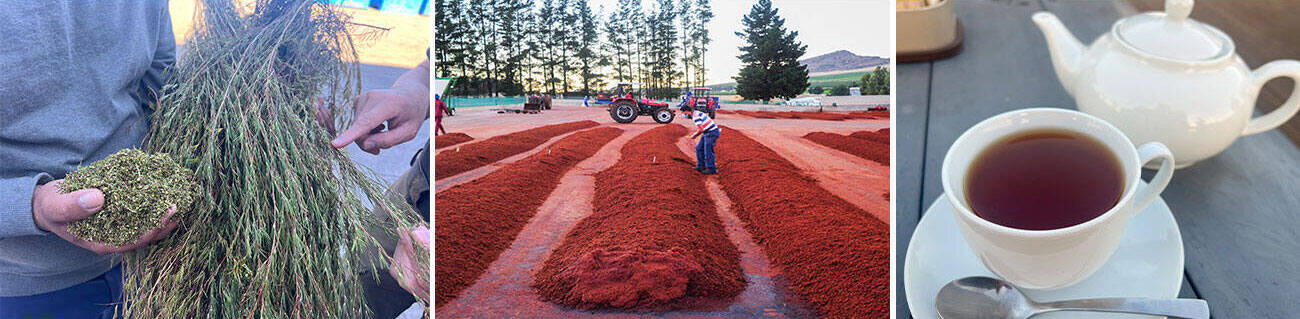
Rooibos is a leguminous shrub that grows only in the Cederberg Mountains north of Cape Town. Rooibos tea is made from the leaves of this tree. When the fermented and dried leaves are brewed with hot water, the resulting tea turns red like black tea and has a subtle sweetness. In Japan, it is popular as a caffeine-free health drink containing antioxidants.
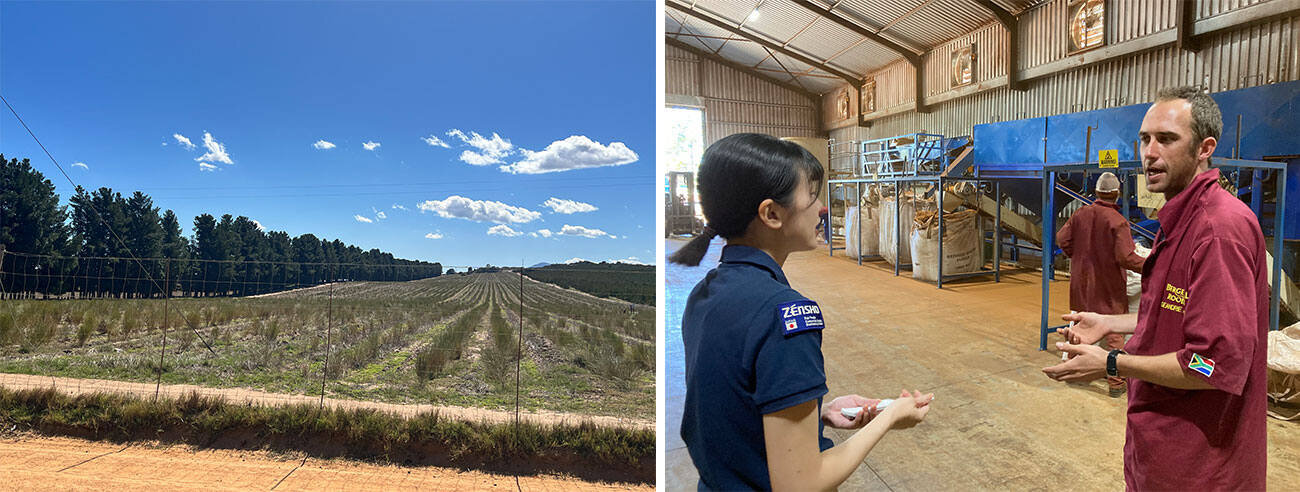
During this visit, we inspected the rooibos fields, processing procedures, and the use of social development costs. The rooibos is organically grown in 20 fields amidst vast natural surroundings, and quality control is thoroughly implemented at the factory.
* social development costs: This refers to the portion of the raw material purchase price that is allocated to various activities aimed at improving the lives of local people.

In South Africa, crime is on the rise and security is deteriorating due to factors such as widening income inequality, drug proliferation, and an increase in illegal immigration from neighboring countries. Because using public transport is dangerous, Zensho used social development costs from fair trade to purchase a bus to transport employees involved in rooibos tea production and children attending after-school programs. This bus has made it possible for employees and children to commute to work and school safely, and now about 500 people use the bus every day.
Zensho will continue its commitment to fair trade with South Africa.
Share this article


![Aiming for fair trade that gives women's voices a chance to shine [Burundi]](/jp/action/resource/img_260528_fairtrade_01.jpg)
![Creating a sustainable society through environmentally conscious coffee production [Tanzania]](/jp/action/resource/img_260312_fairtrade_01.jpg)